
The Slip
One accumulator slip, one Premier League shirt-front ban, and the awkward economics of what happens when football removes a gambling logo from the most visible surface but leaves the demand for that visibility intact.
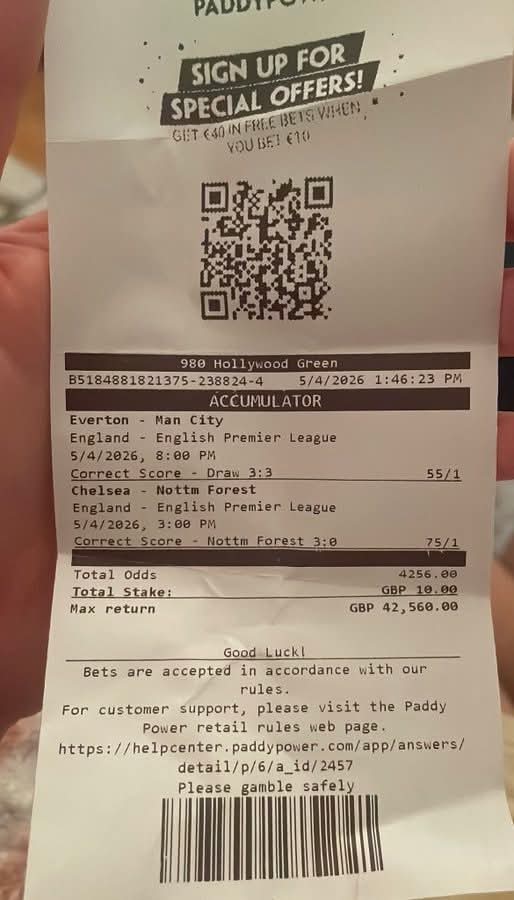
The slip
On Monday 4 May 2026, a man in north London walked into a Paddy Power betting shop on Hollywood Green, paid ten pounds, and received a printed slip on which the largest figure was £42,560. He had placed an accumulator on two Premier League correct-score markets: Everton against Manchester City to end three-three, and Chelsea against Nottingham Forest to end three-nil to Forest. Correct-score accumulators are useful objects for our purposes because they are not subtle. They put the fantasy where the reader can see it.
The slip is accounting, but only in the narrow sense that a cinema ticket is accounting. It records a transaction, yes. It also advertises the product to the person holding it, to anyone he shows it to, and to anyone who later sees the photograph. Somewhere near the top is an offer that turns a first deposit into free bets. Somewhere near the bottom is the instruction to gamble safely. Between them, in the part of the page human eyes are built to find, is the number that turns ten pounds into roughly a year's take-home pay for the median UK household.
It nearly worked. Everton and Manchester City did, in fact, draw three-three in the late kick-off; Nottingham Forest, against expectations, were three-nil up at Stamford Bridge with five minutes left on the clock. The slip was, in financial terms, deep in the money. In the ninety-third minute, Chelsea's João Pedro produced an overhead kick that pulled one back, and the piece of paper that had been worth £42,560 to the man holding it the moment before was worth nothing the moment after. Forest did the much more probable thing of winning three-one, and the difference arrived in stoppage time. A near-miss of that shape is not a failure of the product. It is, in a sense the industry would not put quite so plainly, the product.
This was one customer, one shop, one Bank Holiday Monday. It was also a small receipt for a much larger system. The operator priced the market. The league supplied the matches. The broadcaster supplied the audience. The regulator decided which words could be printed, and which warnings had to be printed smaller. The Premier League, meanwhile, was preparing to remove gambling logos from the front of matchday shirts at the end of the 2025/26 season. So the question is not simply what happens to the slip. The question is what happens to the space around it.
The gradient
The Premier League's gambling economy is easiest to misunderstand if you picture it as a row of shirt fronts. The shirt front is just the most legible surface. The real market is the bundle of attention around a club: shirt, sleeve, training kit, LED board, app, concourse, website, academy page, broadcast feed. A sponsor does not buy a rectangle. It buys a route to an audience.
In the public sponsorship data underlying this site's betting agreements map, twenty-nine distinct gambling operators have some form of relationship with nineteen Premier League clubs in the 2025/26 season. The average is three or four agreements per club. The average is also the least interesting number in the dataset. The shape matters more: who carries one partner, who carries eight, and which kind of operator clusters at each end.
The supply side
The nineteen clubs of the 2025/26 Premier League, plotted by 2024/25 total revenue against the count of betting-partner agreements each currently holds. Hover any dot for the club's league position (final 2025/26 table), revenue, and full sponsorship roster.
Revenue figures are 2024/25 total turnover (£m): Premier League clubs from ValuBall's 2024/25 Money League compilation; the three promoted clubs (Leeds, Burnley, Sunderland) from their published 2024/25 Championship accounts. Promoted-club figures are Championship-season turnover and will rise substantially in their first Premier League season — the slope shows the base from which they entered the league, which is the relevant frame for the partnership decisions they had already made by the time of promotion. Partner counts are exact, from the public sponsorship data underlying this site's Premier League betting agreements page.
At one end are Manchester City, Arsenal, and Tottenham, with one declared betting partner each. At the other are Bournemouth with eight against £182m of revenue, Sunderland with seven against only £40m of Championship-season turnover, and Nottingham Forest with six against £222m. The Big Six average 1.8 betting-partner agreements per club on revenues running from roughly £490m to £700m. The bottom six clubs by 2024/25 turnover, three of them promoted from the Championship, average closer to five. That does not prove one clean causal story, because commercial life almost never gives us one. It does show the outline of a bargain.
Bournemouth's eight, named: 8xBet, 32RED, Betway, BJ88, Bet365, Betano, SBK, and Unibet. Bet365 and Betway are familiar names; Unibet, 32RED, and Betano are well-known to UK regular gamblers and unfamiliar to most other people; SBK is a UK-licensed betting exchange most readers will not have used; 8xBet and BJ88 are brands whose UK consumer presence is, charitably, minimal. This is what the high end of the gradient looks like in practice: a club selling many smaller doors into the same broadcast house.
The low end is shorter because the largest clubs can sell scarcity. Manchester City does not need eight regional gambling partners when Etihad, Puma, OKX, global broadcast value, merchandise, and matchday income have already filled most of the commercial table. A club whose revenue base is measured in the high hundreds of millions can charge for exclusivity. A club living closer to the floor sells more inventory, more often, to more buyers.
So be careful about the claim. The gradient is not destiny. It mixes revenue need, negotiating leverage, club reach, and the fact that some sponsors only want certain overseas audiences. But the practical conclusion survives all of those caveats: the further down the revenue ladder a club sits, the more gambling inventory it tends to carry. Removing that revenue from the bottom of the table is a different policy problem from removing it at the top.
The first disguise
A reader who has watched Premier League football on television over the last few years will recognise some of the names on the gradient as they pass across the perimeter LED boards in the second half — 8xBet, BJ88, BK8 — without ever having encountered them in any other consumer context. That is by design. The customer 8xBet exists to acquire is not the man who walked into the Paddy Power on Hollywood Green. The customer 8xBet exists to acquire is in Vietnam, the Philippines, or Hong Kong, and 8xBet's presence at a Bournemouth match is a way of being visible to that customer through the Premier League's global broadcast footprint without taking on a UK consumer presence directly.
The cluster, named in full: 8xBet, BJ88, BK8, Fun88, W88, Net88, Nova88, Kaiyun, DEBET. They appear, in various combinations, at Bournemouth, Forest, Wolves, Sunderland, Burnley, and several other mid-table-and-below clubs. None of them advertises on UK television outside the Premier League broadcast feed; none of them runs UK retail outlets; none of them has a UK consumer marketing campaign that most readers of this essay will have seen. Their UK visibility is, almost without exception, the perimeter LED board at a Premier League ground and the back of a sleeve patch on a replica shirt.
This is the first version of the category the rest of this essay needs: the not-gambling tier. By that I mean products that function as gambling for the customer they want, while arriving on a surface where the relevant regulator does not treat them as ordinary domestic gambling advertising. The phrase is inelegant, but so is the thing it describes.
The structural mechanism that allowed them to be visible without being licensed in the UK was, until recently, a UK-domiciled entity called TGP Europe, which held a UK Gambling Commission licence to provide white-label gambling services. In May 2025 the Gambling Commission said TGP would have to pay a £3.3m penalty and make significant improvements after anti-money-laundering and business-partner checks failed. TGP instead surrendered its licence and left the British market. The Asian regional partner tier did not vanish with it. The mechanism is what matters. When one fronting entity leaves the regulatory perimeter, another can arrive, because the demand to be visible at Premier League grounds is structural.
The major UK-licensed operators sit on the gradient alongside the Asian regional partner tier, not against it. The slip the man in Hollywood Green received was printed by Paddy Power, a brand of Flutter Entertainment. Bet365, privately held and headquartered in Stoke, is the other major UK-licensed operator on the gradient. The major operators do not need a fronting entity because they hold their own UK licences. They are present for the same reason the Asian regional partner tier is present: the visibility-per-pound calculation works in football and works almost nowhere else outside it.
The slot
This is where an economics lecturer, if allowed near a whiteboard, would draw a rectangle and ruin your afternoon. The rectangle is the slot: the visible commercial surface attached to a football club. Front of shirt is the famous rectangle, but the same logic applies to sleeves, LED boards, training kit, academy pages, app integrations, and broadcast inventory. A club has attention. A sponsor has demand for that attention. The argument starts when one sponsor category is told it can no longer buy one of the rectangles.
In 2012, Newcastle United signed a four-year shirt-sponsorship deal with Wonga, a payday-lending company whose advertised annual percentage rates ran into the four-figure percentages and whose customer base was, by its own marketing, financially marginal. Wonga was fined £2.6m in 2014 for sending fake-law-firm letters to debtors, and in 2018 the company collapsed under regulatory pressure and a flood of compensation claims. The collapse closed the Wonga slot at Newcastle.
It did not stay closed. By the start of the 2017/18 season, Fun88 — an Asian regional gambling operator whose UK consumer presence was and remains minimal — was on the front of Newcastle's shirt. The successor product was different in category, regulator, and visible audience from its predecessor, but the slot itself had not closed even for a season.
The thesis is conditional, not mystical. Bans on a single visible commercial surface tend to relocate inventory rather than reduce it, because the demand to reach the audience does not disappear when one rectangle is removed. It looks for the next rectangle. When the ban covers the substitution surfaces too, reduction can dominate. When the surface is not valuable enough to resell, the slot can simply lose value. But narrow bans are relocation machines. They are very good at moving the thing you can see.
The cleanest counter-example is tobacco in Formula One. The Tobacco Advertising and Promotion Act 2002, supplemented by the EU directive that followed, removed tobacco branding from the visible surfaces of motorsport. The slot did not refill one-to-one with the next vice category because the regulatory architecture covered the substitution surfaces too: television, print, in-event visibility, livery, merchandise. A smaller counter-example is children's replica football kit. Alcohol logos came off those shirts and mostly stayed off, not because nobody wanted a rectangle, but because that particular rectangle lost value when the category that most valued it left.
Italy's Decreto Dignità sits between those cases. It banned gambling advertising in 2018 and removed meaningful domestic sponsorship revenue from Italian football. Some inventory relocated. Some revenue left. The ban was broad enough to cover much of the substitution surface, but Italian clubs also lacked the Premier League's global broadcast reach, which is what makes Asian regional visibility so valuable. Italy is evidence for both sides if you are determined to win an argument. It is more useful as evidence that the width of the ban matters.
The Premier League's 2026/27 ban is narrow: front-of-shirt only, in one country, with sleeves, training kit, perimeter LEDs, international broadcast feeds, club apps, and partner categories still available. The thesis predicts substantial relocation rather than substantial disappearance. Not perfect relocation. Not pound-for-pound replacement. But relocation as the dominant behaviour of the system.
The strongest case for keeping the slot
The strongest argument for keeping gambling sponsorship visible is not that betting companies are charming civic institutions that simply love sleeve patches. It is that the football economy has already priced them in, and the alternatives are messier than the slogan makes them sound.
Start with the values case, because the values case is real. Adults in the United Kingdom are allowed to spend their leisure money on activities with negative expected value. They can drink, smoke, buy lottery tickets, drive cars too quickly, and spend a Monday trying to turn ten pounds into a small salary. The regulator's own family data is mixed rather than melodramatic: some young people in gambling households report benefits, some report tension, and most report neither. That is not an argument that harm is imaginary. It is an argument that the median case is not the same thing as the worst case.
Then comes the commercial case. Karren Brady has put the premium from gambling shirt deals at around forty per cent over equivalent non-gambling sponsors, and said that at smaller Premier League clubs those deals can amount to twenty per cent of commercial revenue. Even if the exact number moves club by club, the scale matters. Twenty per cent of commercial revenue is not the loose change in the drawer. It changes the wage budget, the transfer budget, and the number of mistakes a club can survive.
Italy supplies the awkward natural experiment. The Decreto Dignità removed gambling advertising at scale and Serie A clubs report a large annual sponsorship loss. You can read that as evidence for the ban: visible gambling inventory really did leave the domestic football product. You can also read it as evidence against a narrow version of the ban: commercial revenue fell more visibly than measurable harm. The honest conclusion is annoying, which is usually a sign it is getting warmer. Italy shows reduction, relocation, and fiscal pain at the same time.
The substitution case is the industry's strongest non-sentimental argument. If demand for gambling is not created by the logo, removing the domestic logo may shift some demand to offshore operators with weaker age checks, weaker affordability controls, weaker exclusion systems, and less reason to fund harm reduction. This is the Betting and Gaming Council's favourite argument, because trade associations enjoy arguments in which their members become consumer-protection infrastructure by comparison with someone worse. It is still a real argument. A bad messenger does not make a good point false.
Prediction markets add a cleaner conceptual wrinkle. Robin Hanson's version of the case is that a peer-to-peer prediction market is an information-aggregation mechanism, not a bookmaker. In the narrow mechanical sense, he is right. A matched contract market is not the same thing as Bet365's pricing engine. Betfair has traded on that distinction for a quarter of a century. The useful critique is not to pretend the structure is identical. The useful critique is to ask why the structural distinction matters less and less as the user-facing product becomes a sports-betting interface with better lobbyists.
Finally, there is the unpleasant broadcast-rights argument. Football's commercial economy is partly downstream of betting interest. Not entirely, not secretly, not in the lurid sense that every viewer is watching through an accumulator. But in-running betting creates attention for matches whose sporting question has already faded. Official data rights have real value because bookmakers need reliable event data. The strongest defence of visible sponsorship is therefore not that gambling is outside football, generously subsidising it. It is that gambling is already inside the demand structure. The shirt-front ban changes attribution. It does not change that structure.
Taken together, that is a serious defence. It is not beautiful, and it is not the kind of defence you put on a poster. But it is serious. Gambling sponsorship is lawful adult entertainment, meaningful club revenue, regulated domestic infrastructure, a contributor to football's demand curve, and in some new forms a genuinely different market structure. The mistake is assuming that because those points are industry-convenient, they are automatically unserious.
What the ban solves
The defence above does not collapse the case for intervention. It tells us what kind of intervention we are looking at. The 2026/27 ban is not a moral settlement on gambling. It is a coordination mechanism for one surface.
The coordination problem is simple. If one smaller club walks away from gambling money alone, it bears a revenue cost while competitors keep the money. If all clubs are required to walk away from the shirt-front slot together, the unilateral punishment disappears. That is the polite public-policy version. The impolite version is that everyone at the table knows the money is embarrassing, but nobody wants to be the only club embarrassed and poorer.
That does not mean the ban makes everybody better off. Italy is the warning here. A coordinated exit can solve the prisoner problem and still remove money from the football economy. The policy question is whether the externality from visible gambling sponsorship is large enough to justify that loss. That is a more honest question than pretending the revenue was fake, or pretending the logo was harmless because the revenue was useful.
Nor does the ban answer the demand-side objections. It does not stop the man in Hollywood Green from placing the accumulator. It does not stop in-running betting from adding value to dull second halves. It does not stop offshore operators from taking high-risk customers. It does not decide whether prediction markets are gambling, information markets, or a beautiful example of why legal categories should not be allowed to drink before naming things.
It does one narrower thing. It says that the most famous commercial rectangle in English football will no longer carry gambling logos. That is not nothing. The front of the shirt is not just another pixel in the media plan; it is the surface children draw when they draw a football kit. But if the policy is evaluated as a demand-reduction mechanism, it will disappoint. It is a visibility policy. Visibility policies move attention before they move behaviour.
The fair description, then, is neither the industry's "nothing to see here" nor the clean moral victory version. The ban solves a real coordination problem on a real symbolic surface at a real commercial cost. It does not solve gambling demand, offshore substitution, or the next product's regulatory self-description. Half-measures are not always cowardice. Sometimes half is the jurisdiction.
The page above his name
In September 2024, an audit of Premier League club websites for gambling-operator content placed on pages aimed at children and young people, conducted by the Pitch Inspection newsletter and reported in the Guardian, identified ten clubs with gambling-operator placements on children's-section pages. Liverpool's International Academy page, aimed at prospective youth-development applicants, hosted a Ladbrokes logo and a link to a £20-bet-offer landing page. Nottingham Forest's under-ten-to-sixteen girls' academy section carried a Kaiyun logo and a link. Newcastle United's under-eighteen and academy sections carried three simultaneous gambling-operator links.
The UK Gambling Commission's 2025 Young People and Gambling survey, conducted on a sample of 3,666 pupils aged eleven to seventeen, reports that thirty per cent of respondents had spent their own money gambling in the previous twelve months. The problem-gambling rate, measured against the DSM-IV-MR-J screen for adolescent problem gambling, was 1.2 per cent of the sample. The at-risk rate was 2.2 per cent. The headline rise in own-money gambling was, on the regulator's own analysis, driven specifically by unregulated gambling: products outside the Gambling Commission's licensing perimeter.
A complementary University of Bristol study across a single Premier League weekend identified 6,966 distinct gambling-related messages across six live televised matches. Less than a quarter carried any harm-reduction message. Less than a fifth carried an age warning. The study also found that most of the social-media marketing analysed was not identifiable as advertising under the Advertising Standards Authority's own transparency rules. Six matches, 6,966 messages. You do not need to think every exposure creates a problem gambler to see that the surface has become saturated.
There is a more honest reading of the harm data than the harm figures alone allow. The same UKGC survey that produces the thirty-per-cent and 1.2 per cent figures also produces the family-level mixed-outcome data: nine per cent of young people whose family members gamble report it helped pay for things at home, against seven per cent who report tension. The remaining roughly five-sixths report neither outcome. The harm figures matter not because they characterise the median family experience, but because problem gambling is acute and concentrated in the population it affects. A system can be ordinary for most people and devastating for some people at the same time. Many things worth regulating have that shape.
The financial circuit that connects the man in Hollywood Green to the academy player in the Pitch Inspection findings is short, traceable, and boring to describe in detail, which is part of why it is rarely described in detail. The man's ten pounds funded an operator margin that funded a free-bet promotion that ran on operators whose logos appeared on the academy page above the name of someone else's child. The point is not that the man with the slip did something wrong. The point is that the system routed ordinary adult leisure through surfaces built for people who are not allowed to participate in it.
The 6,966 messages a weekend, the academy-page bet offers, the social feeds half-saturated with gambling content: this is what the current institutional response is for. While that response works through its three-year timetable, the next form of the not-gambling tier is already arriving under a regulator whose remit was not designed to cover it.
The new word for it
The institutional response is, by design, slow. The 2026/27 ban was announced in 2023, given a transition window through the end of the 2025/26 season, and built around the slow churn of sponsorship contracts. Faster than the institutional response, in the same period, has been the next form of the not-gambling tier: prediction markets.
Prediction markets are peer-to-peer contract-matching products in which two parties take opposite sides of an event — the outcome of a match, an election, a weather event — at a price that reflects the market's best estimate of the probability. The mechanism is not new; Betfair has run a peer-to-peer betting exchange in the United Kingdom since 2000. What is new is the regulatory move to classify sports event contracts as commodity-futures instruments rather than gambling products. The withqwerty.com prediction-markets footnote, The Price of the Premier League, walks through the mechanics of volumes, wash trading, and binary options. This section is about the laundering of category.
Hanson's structural claim from section five — that peer-to-peer matched markets are not, on their merits, what a bookmaker does — is right, in the narrow sense the claim makes. Kalshi's CFTC-regulated event-contract product and Betfair's UK exchange are both peer-to-peer matched in a way that Bet365's pricing engine is not. The reason that distinction does not end the argument is that the regulator's definitional test is not "is this structurally what a bookmaker does." The regulator's definitional test is whatever the regulator's legislation says it is. Hanson's distinction is preserved. The user-facing product still looks, behaves, and markets itself like something a sports bettor recognises immediately.
In April 2026, ADI Predictstreet was announced as the Official Prediction Market Partner of FIFA World Cup 2026, with integration into DAZN's World Cup streaming product. The counterparty was not Kalshi, Polymarket, or one of the obvious US prediction-market names. It was a Gibraltar-licensed product linked to ADI Chain, with UAE capital reported behind it and a corporate structure trade reporters found conspicuously hard to read.
Front Office Sports, the trade publication that broke the deal, quoted a veteran sports partnerships executive describing the situation as "all very fishy". The interesting part is not the adjective. The interesting part is the category. FIFA gets a partner that is not, formally, a sportsbook. The partner gets FIFA legitimacy before the global regulatory settlement on sports prediction markets has caught up with the product.
Kalshi, the largest US prediction-market platform with a CFTC licence, has already shown how powerful the distinction can be. Sports contracts have become a large majority of its trading volume in recent reporting windows, while the company argues that federal commodity-futures regulation preempts state gambling law. This is the not-gambling tier in its cleanest form: not hidden offshore, not squeezed through a white-label UK licence, but elevated into a different regulator's vocabulary.
Whether you call this gambling or information aggregation depends on how a regulator answers a definitional question about the product, not on what the product itself does. The structure of the product does not change with the answer. The not-gambling tier is doing here exactly what it did when it was the Asian regional partner: describing gambling as something else for regulatory reasons. The names change; the slot does not.
The slot does not stay empty
The story is not about football, and it has not been about football for a long time. It is about who gets to set the terms when a product whose underlying mechanic is gambling is offered through a surface whose underlying mechanic is the cultural attachment a country has to a sport.
At the top of the structure are the people doing the engineering: the fronting entities, the offshore licences, the exchange lawyers, the sport-governance bodies, the commercial departments that can turn category uncertainty into a sponsorship asset. They are not supernatural villains. They are doing what the incentives ask them to do, which is often worse.
In the middle, the clubs. The Bournemouth and Sunderland boards staring at a line item that can approach a fifth of commercial revenue, knowing any single defection costs them alone. The clubs are inside the coordination trap, and the trap is not an opinion they hold; it is the budget they have to balance. The 2026/27 ban is the institutional act that lets them step away from one floor at once.
At the bottom, the people for whom the slip and the academy page are different ends of the same circuit. The man in Hollywood Green, choosing to spend his ten pounds the way an adult is allowed to spend it; the academy player whose club's website hosts a £20 bet offer on the page above his name; the fourteen-year-old whose social feed is half gambling content; the season-ticket holder who used to watch matches and now watches markets. Some of the people at the bottom are getting precisely the leisure activity they came for, at exactly the price they were prepared to pay for it. Some are getting the residue.
The diagnostic model is three questions. First: where did the inventory go? Second: who licenses the thing that replaces it? Third: which regulator is being routed around? The 2026/27 Premier League ban has clear answers. The inventory moves from shirt fronts to sleeves, training kit, perimeter LEDs, club websites, apps, data products, and broadcast integrations. Some replacements are licensed by gambling regulators. Some are licensed somewhere else. Some are not very interested in being described plainly at all.
A different system does not inherently mean a better one. If we replace gambling integration with prediction-market integration, we will not have replaced gambling. We will have learned a new word for it.
Sources and notes
Core factual anchors for this draft: the Premier League's shirt-front sponsorship statement; the Gambling Commission's TGP Europe notice and Young People and Gambling 2025 report; University of Bristol's Premier League gambling-message study; the Guardian and the Pitch Inspection's children's-page audit; the DAZN and ADI Predictstreet World Cup partnership announcement; Front Office Sports' ADI/FIFA reporting; and Axios' Kalshi sports-volume reporting. The Everton-City and Chelsea-Forest match details are checked against contemporaneous AP reporting.